|
Fishing
Whether fly-fishing or spin fishing, the Okavango
River is undoubtedly one of the best freshwater
sport fishing rivers found anywhere in Southern
Africa. Guma Lagoon is one of the most rewarding
locations.
All
types of fishing are offered at Guma Lagoon
Camp. Depending on the season, the prominent
species caught while fishing the lagoon are
catfish, African pike, red breasted tilapia,
three spot tilapia and purple face largemouth.
For those who want to fish the mighty Okavango
River, a 40-minute boat ride from camp that
passes through a narrow meandering network of
channels, will get you there. Fishing takes
place in the channels and waterways around Guma
Lagoon Camp. The Guma area comprises of many
small lagoons, countless small palm fringed
islands, narrow winding waterways amongst dense
papyrus and reeds and the large Guma Lagoon
itself.
Fish
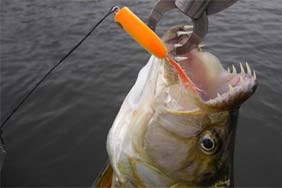
species that can be caught at Guma Lagoon Camp
are tigerfish, nembwe (olive bream), threespot
tilapia, brown spot tilapia, thinface large
mouth tilapia, purple face large mouth tilapia,
African pike, redbreast tilapia, green-headed
tilapia, sharptooth catfish, blunt-tooth catfish
and butter barbel.
Guma
caters for both the conventional angler and
fly-fisherman. To-date the tigerfish record
at Guma Lagoon Camp is 7.2 kg (15.8 lbs), and
the tigerfish spin-fishing record is 6.8 kg
(14.96 lbs).
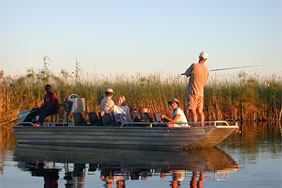
Experienced
local guides accompany all guests on the boats.
When fly-fishing only 2 guests are permitted
per boat. No private boats are permitted at
Guma.
Guma
Lagoon Camp actively supports a catch-and-release
policy for of all fish species.
Mokoro
Trips
The
traditional dugout canoe, locally known as a
mokoro, was the mode of transport chosen by
the Okavango’s first inhabitants, the
Bayei and Banoka people.
Guma Lagoon Camp offers a choice of day trips
or overnight camping mokoro trails that take
you into the heart of the Okavango.
This
is an adventurous safari experience not to be
missed.
From
Guma Lagoon Camp, a 15-minute boat transfer
that passes through a narrow meandering channel
will get you to the start of your mokoro experience.
From
here you will get onto a fiberglass or wooden
mokoro which can seat two people. The Head Mokoro
Poler will then give the group a detailed speech
on safety and what to expect on your trip.
You
will be poled through the tranquil channels
that link the extensive flood plain system to
the main river. Water lily beds, palm islands
and papyrus stands abound making for the most
scenic of experiences. On one of the larger
islands you will have time to have your lunch
and a guided walk. There is always a chance
of seeing large herds of red lechwe bounding
through the water and passing elephants feeding
amongst the lush wetland vegetation.
After
your hearty lunch and walk you will make your
way slowly back to the Mokoro station where
our motorboats will be waiting for you to take
you back to camp.
|